Tuesday, September 4, 2012
An organized swim
The key is my dedicated pool tote bag. Not only is the bag only used for this purpose, but the supplies inside are just for the pool, too. In it are my Master Lock for the locker room, mini bottles of shampoo and body wash, a brush and sunscreen. Inside I keep my flip flops, goggles and a sun hat. I add my towel, bathing suit and clean clothes to the main pocket. I also bring a bottle of water and a bag of almonds in my purse for afterward.
When I get home, the wet stuff either goes in the wash or gets rinsed and put on the drying rack. The bag with everything else returns to my closet -- already packed and ready to go for next time!
Tuesday, July 10, 2012
Top 5 packing tips
According to Inc. Magazine (June 2012), the amount airline passengers were charged in baggage fees in 2010 was an astounding $3.4 billion. Obviously, what makes economic sense to the airlines does not make economic sense to many of its passengers. Checking bags is now a luxury we may not be able to afford. Therefore, packing light has never been more attractive. Aside from the time and money saved by not checking bags, it can be liberating to travel light and have less stuff to worry about when in transit. Here are my top packing tips:
- Pack clothes in easily washable and quick drying fabrics like nylon or polyester, or at least cotton blends containing such materials. Hand wash as needed.
- Wear one set of all-purpose jewelry on the plane and skip packing alternates.
- Take some of your savings from not checking a bag, invest in an e-reader and forgo heavy paper books and magazines.
- Use packing cubes - they really work to pack the most amount of stuff into a small space.
- Remember - wherever you're going, they probably have stores that sell toothpaste, underwear and batteries, so don't panic if you forget something or run out of supplies.
Thursday, March 29, 2012
Stockpiling pros and cons
I hate buying something just in case I might need it later, but because I don't know exactly what I'll need once the baby arrives, and I won't want to be in a position where I have to go out to get something urgently, I'm trying to let go of my worry that I won't use the thing. For instance, medicine is one thing I hate buying without knowing if I'll need it, because it will expire, but it's also something you want to immediately available if you need it!
The pros of stockpiling are definitely the niceness of having what you need when you need it, as well as a feeling of preparedness. And for items I know will get used, such as chicken broth and toilet paper, I'm happy to have as much on hand as I have room for.
![]() |
| In my house, you can't have too much peanut butter on hand! |
Tuesday, March 27, 2012
Post-natal meal planning
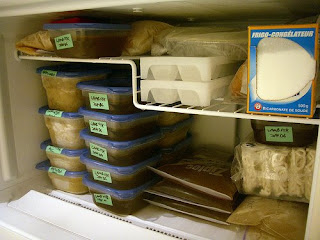
I have a small freezer, and I've had to make some choices about what to keep in there. I pared down my ice pack collection, and have been using up the ends of bags of lima beans and blueberries, which is good to do once in a while anyway.
Then I made beef stew, minestrone soup and whole wheat spinach lasagne (and put them in labeled, meal-portion containers). Which just about taps me out space-wise. But that's still at least 9 solid meals worth, and it gives me a little peace of mind knowing that my family and I won't be entirely dependent on the kindness of visitors or the prepared foods section of Whole Foods!
Monday, January 16, 2012
The importance of an alarm clock
I'm not a fan of the sleep function on alarm clocks. I think alarm clocks are most effective when they are set for the time that you must get up, or perhaps ten minutes earlier, so you can at least lie in bed for a minute and collect your thoughts if you like. If you tend to fall asleep again immediately after shutting your alarm off, placing it out of arm's reach so you have to get up in order to turn it off really does work.
I'm also not a fan of using one's cellphone as an alarm clock. This works for a lot of people, but it means that psychically we're dependent on our phones, even as we sleep, and that doesn't seem healthy. Personally, I like an alarm that wakes me up by gradually increasing the volume of preselected music...it's gentle and effective. I consider myself a morning person and when I'm in a routine, I often don't even need to have an alarm set in order to wake up at a predetermined time. But I set one anyway.
Creative Commons photo posted to Flickr by Alan Cleaver.
Tuesday, September 20, 2011
How to make grocery shopping less of a chore
Now I live about an eighth of a mile from a medium-sized supermarket, five minutes from Trader Joe's, with a Whole Foods smack in between, and shopping threatens to become more of a chore than it should be. I still live by my list, but the problem is that I often have to go to at least two of those stores on any given trip in order to cross everything off. So I've tweaked my shopping style and have a few tips to help make the process more enjoyable:
- I keep a running list of items needed, then before I plan to go to the store, I check all the recipes I intend to make in the coming week and fill the list with needed items. I do a quick walkthrough of the house to make sure I'm not forgetting something like toothpaste. This cuts down on forgetting anything and decreases the frequency I need to shop.
- I've pretty much given up on coupons, unless I happen to come across one that is for something I already buy and use. I find that if it is for something I use, but a different brand, then the savings the coupon represents still don't make up for the price difference against the brand I usually buy, so I'm not really saving money. I also don't have to worry about remembering to take them with me or pull them out at checkout.
- Of course, I always bring my own bags. Remembering to do this every time is a point of pride with me, and I prefer my own sturdy and pretty bags to disposable ones anyway.
- I bring a bottle of water and stay hydrated. Especially if I'm going from store to store, I always get thirsty walking around with a cart, and drinking water helps me feel better and cuts down on impulse buys like expensive smoothie-type drinks.
- I try to time my shopping so when I arrive home laden with bags, my husband is home and available to help me unload. We live up two steep flights of stairs, and while the exercise is good, it's also nice to share the load.
- I stock up on dry staples wherever I can, so sometimes I can get away with a short, light shopping trip one week (fruits, veggies, milk) alternated with a staple-heavy trip the next.
Friday, July 2, 2010
A year ago: purse organization, book review and packing tips
Recommendations for the eight things everyone should have in their purse in order to be organized for every day. Another good one that I didn't mention: reusable bag for those quick trips to the drug store or grocery store. You will avoid picking up extra disposable ones and sometimes they give you a discount.
I reviewed the book Organized to be Your Best! by Susan Silver. This book has very detailed and specific instructions for creating organization in your home and work life and is recommended for people who want to get a bit deeper into their systems than with a book like Organizing Outside the Box, for instance.
Last year before my summer trip, I was still in checked-bag mode and hadn't made the switch to quasi-minimalist carry-on only packing. Here are my tips for smooth packing.
Lelah Baker-Rabe is a Los Angeles-based professional organizer. To discuss your organizing needs, call her at 818.269.6671 or email lelah@lelahwithanh.com
Monday, June 7, 2010
A year ago: preparing for every day, storing recipes and keeping it together
An exhortation to follow one of the primary rules of organizing: keep like items together.
My three-part series on how to organize recipes, from cookbooks to individual loose recipes to digital ones. I still think these are the best ways to go about managing what for my cooks is a losing battle with new recipes coming in all the time. My loose recipes have over time moved from file folders to clear sleeves in a binder, but both work.
Lastly, in the first installment of my preparing for everyday series, I write about what every prepared person should have in their desk drawer.
Creative Commons photo posted to Flickr by cleverclevergirl
Lelah Baker-Rabe is a Los Angeles-based professional organizer. To discuss your organizing needs, call her at 818.269.6671 or email lelah@lelahwithanh.com
Tuesday, January 12, 2010
Preparing for every day: Illness
- Electronic thermometer
: Having a thermometer on hand is essential to knowing for sure if someone has a fever, which can aid in diagnosis and deciding whether or not you should stay home from work.
- Cough drops: The menthol ones are very popular in our household.
- Mild cough suppressant: I like the non-non-drowsy kind for nighttime rest. (Dimetapp
, even though it is advertised for kids, does the trick.)
- Tissues: When you’re sick, blowing your nose into falling apart toilet paper doesn’t make it better.
- Canned soup: Broth-based soups just have something about them that makes you feel like you are treating your cold or flu, not just getting nourishment. Plus, they are easy to prepare and eat.
- Soft, cold foods like popsicles and applesauce are a nice treat.
- The phone number of your doctor. Even if you don’t get sick often, it is a good idea to have the name and number of someone you can call if you do happen to have something that requires antibiotics for instance. You don’t want to be doing research into local practitioners while you are sick; you want to do that beforehand, when you are healthy and up to that task.

Creative Commons cough medicine photo posted to flickr by whiskeyandtears
Creative Commons tissue box photo posted to flickr by vieux bandit
Lelah Baker-Rabe is a Los Angeles-based professional organizer. To discuss your organizing needs, call her at 818.269.6671 or email lelah@lelahwithanh.com
Wednesday, December 2, 2009
Preparing for every day: Gift wrap station
I hardly ever actually buy ribbon or wrapping paper, instead I save the good stuff that I receive from birthdays and holidays. I find the recycled stuff looks just as good as new, and I've saved myself the expense. Ribbons, in particular, if well-made, can be reused over and over again. My recommendation is to keep one box worth of wrapping paper and one box of ribbons, bows and tags. To make large wrapping projects easier, look into getting a box long enough to hold tubes of wrapping paper. Vertical tube holders don't work well in my experience. I recommend long, flat, clear plastic boxes to hold the following items.
The 9 things that should be in every gift wrapping kit:
- Transparent tape, the kind that comes in an open, weighted dispenser rather than a disposable dispenser as it is easier to use with one hand.
- Good quality, large scissors.
- Tissue paper in various colors.
- Wrapping paper in various colors.
- Ribbon in various colors.
- Gift tags or card stock for creating tags.
- Single hole punch for threading ribbons through tags.
- Sharpies, of course! I recommend at least black, but silver Sharpies add a festive touch at holiday time.
- Post-its. I like to use Post-its to remind me what is inside a wrapped package and who the recipient is if I am wrapping several items at once and might mix them up, or if they are awaiting tags or cards.
Thursday, September 3, 2009
Preparing for every day: Glove compartment
Our cars are an extension of our homes and we spend a ton of time in our cars every week. A glove box or glove compartment is not a place to store empty candy wrappers and take out packets of soy sauce (or, usually, actual gloves). To the contrary, a neat and orderly glove box with a few necessary items can make stressful times like traffic accidents and being pulled over a little bit less intense.
The 7 things that should be in every glove box:
- current registration for your car (not the registration for every year since you’ve owned the car)
- current insurance information (again, not every insurance period is necessary. Just what is valid now)
- pad of paper
- 2 pens
- area map (even if you have GPS)
- extra sunglasses
- travel pack of tissues
Lelah Baker-Rabe is a Los Angeles-based professional organizer. To discuss your organizing needs, call her at 818.269.6671 or email lelah@lelahwithanh.com
Monday, August 31, 2009
National Preparedness Month

I’ve already written about preparing for every day, as well as a bit about preparing for emergencies. Preparedness means being physically and mentally ready for something that is coming down the road. In this sense, organized people are almost always preparing for something. Brushing our teeth and flossing in the morning means we’re preparing to get good marks from our dentist at our check up in three months, as well as preparing to show off our smile to our significant other and to have a successful day at work not worried about our breath. Preparation takes forethought and a bit of effort, but much less effort than it takes to scramble to get something done that could have been done ahead of time.
Preparedness comes in many forms. It can mean preparing for your child to be ready for the school year by stocking up on school supplies, new shoes and getting them a haircut. It can mean preparing for an earthquake by making sure you have adequate earthquake insurance in addition to food, water, cash, battery powered lights, etc. located in your home, office and car. Preparedness can also mean being ready for a flash of inspiration by keeping pen and paper in your purse. You can write down ideas for your blog, phone numbers and email address and a reminder that you need an oil change—something you might remember in the car, but forget by the time you get into your house.

So, in honor of National Preparedness Month, take a moment to think about your life. Are you prepared for dinner tonight (meal prep, clean dishes)? How about for work tomorrow (clean clothes, lunch, presentation materials)? What about for the possibility of getting in a fender bender on the freeway (insurance and registration, paper and pen to exchange details in your glove box) or having your hard drive fail (external back up hard drive or remote storage via the Internet)? Pick one thing you’ve been putting off getting prepared for (making a will, figuring out Thanksgiving plans) and decide to do it this month!
Screenshot from National Preparedness Month website.
Creative Commons photo posted to Flickr by Seattle Municipal Archives
Lelah Baker-Rabe is a Los Angeles-based professional organizer. To discuss your organizing needs, call her at 818.269.6671 or email lelah@lelahwithanh.com
Wednesday, July 29, 2009
Preparing for every day: Freezer

Did you know that freezers work more efficiently when they are filled up? Mark Bittman a.k.a. The Minimalist writes eloquently about freezer use in this fantastic NY Times article. It is a must-read! The following items are great to have on hand for last minute dinners, guests and to supplement your pantry. Freezing is a time saver--next time, make twice as much pizza dough as you normally would, and freeze the rest for a few weeks from now when you're too tired to make dough from scratch. It feels good to know that even if your fridge is empty, you'll have something edible in the freezer.

The 12 things that should be in every freezer:
- ice cube trays (some filled up with water, some available to be used for leftover coffee, juice, or to save herbs, citrus, etc.)
- vodka (great for spur of the moment cocktails, pie crust and other cooking)
- frozen peas (makes a good ice pack in a pinch)
- ground meat frozen in meal-sized portions
- leftover pancakes (can be microwaved or re-heated in oven)
- frozen juice concentrate
- homemade chicken stock in single-recipe portions
- homemade pizza dough (I like Bittman's recipe)
- store-bought puff pastry (a little expensive, but highly useful)
- pie crust (store bought or homemade)
- over-ripe bananas (peeled, to be used for banana bread)
- ice packs for on-the-go food chilling and minor injuries
- Sharpie for labeling (name and date each item that goes in there!)
- Good quality freezer bags
- Good quality plastic or glass storage containers
Lelah Baker-Rabe is a Los Angeles-based professional organizer. To discuss your organizing needs, call her at 818.269.6671 or email lelah@lelahwithanh.com
Friday, June 12, 2009
Organizer’s blog digest 3

One of my newest favorite blogs, Organizing-Life, has seven tips for less stress today. Stress is often caused by putting things off that we know we need to do. Actually doing the things is almost never as hard as the mental and emotional strain of thinking about doing it!
The always helpful Lorie at The Clutter-Diet Blog gives us Ten Essential Closet Maintenance Habits. When it comes to closets, maintenance really is the name of the game.
This week several other professional organizers and myself participated in a "Blog Carnival" put on by Your Organizing Business blog. I chose to share my post about emergency preparedness, and you can catch more awesome posts from other organizers and business people there.
Tuesday, June 9, 2009
Preparing for every day: Purse

(It doesn't count as prepared if you can't find what you are looking for!)
The 8 things that should be in every purse:
- lip balm
- Emery board
- tissues
- ONE place that keys always go
- ONE place that a cell phone always goes
- id/wallet/billfold that has a stash of emergency cash for parking etc.
- “feminine products” (even if you don’t need them, you’ll be able to come to a friend’s rescue once in a while)
- chocolate (or something else to nibble on when stuck in traffic. I like Tootsie Rolls because they don't melt)
That is my no means all I have in my purse, but these eight things we use all the time, need almost every day, and are real time savers when we have them at our fingertips. However, a purse (or briefcase or satchel or man-bag) is practically a sacred space and I’m sure there are things you must have in yours that wouldn’t occur to me to have in mine. What must-have preparedness item do you have in your bag? Matches? Band-aids? Share in the comments.
Creative Commons purse photo 1 posted to flickr by eyesogreen
Creative Commons purse photo 2 posted to flickr by all of olive
Lelah Baker-Rabe is a Los Angeles-based professional organizer. To discuss your organizing needs, call her at 818.269.6671 or email lelah@lelahwithanh.com
Monday, June 8, 2009
Preparing for every day: Desk drawer
This drawer is pretty organized and has a bunch of the recommended items.
The 12 things that should be in every top desk drawer:
- lip balm
- Emery board
- scissors
- binder clips
- pencil sharpener
- ruler
- staples and stapler
- tape and tape dispenser
- scrap paper and Post Its
- glue stick
- calculator
- permanent marker
These are the things we use all the time, need almost every day, and are real time savers when we have them at our fingertips. Trying to keep only those items we use every day will make it easier to find things . I’m sure there are other tools you swear by in your desk drawers. Feel free to add more in the comments.
Creative Commons desk drawer photo posted to flickr by Mickelodeon
Lelah Baker-Rabe is a Los Angeles-based professional organizer. To discuss your organizing needs, call her at 818.269.6671 or email lelah@lelahwithanh.com